How to Build a Craft Portfolio That Shows Your Process
A craft portfolio can show more than finished work. Learn what to select, photograph, caption, and arrange so viewers can understand your skills and choices.
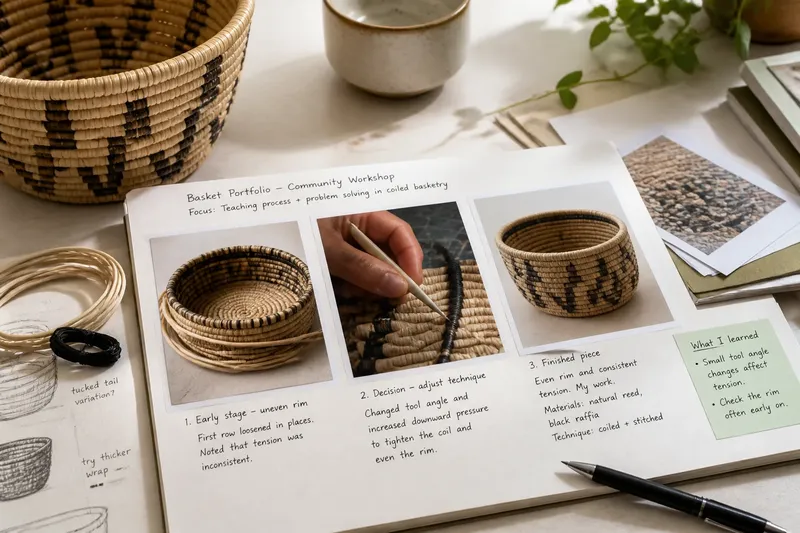
You have a finished woven basket on the table, a phone full of workshop photos, and no clear idea what belongs in a portfolio. A strong craft portfolio helps a viewer see not only what you made, but how you think, solve problems, and develop a piece.
Start by deciding who will view it and what they need to understand. A portfolio for a teaching opportunity may need process notes and learning goals; one for a craft fair or commission may need finished work, materials, and the kinds of pieces you can make. Keep the selection focused rather than treating every saved image as equally useful.
Choose a clear purpose
Write a plain sentence describing the portfolio’s purpose, such as “show my progress in hand-built ceramics” or “present examples of my basketry for community workshops.” That sentence becomes a filter: each image or note should support it.
Think about the viewer’s likely questions. They may want to know what you made, which parts were your contribution, what materials and methods you used, and what you learned along the way. If a piece was collaborative, say who did what and credit the other makers.
Select telling work
Choose a small, varied group of pieces that demonstrates the skills relevant to your purpose. Include work that shows different materials or techniques when those differences matter, but avoid adding a piece simply to make the portfolio longer.
For each candidate, ask:
- If the piece clearly supports your stated purpose, include it; if not, leave it out or place it in a separate archive.
- If the image shows a skill you want viewers to notice, keep it; if the skill is hidden, choose a clearer view or add a process image.
- If the piece is unfinished but explains an important decision, include it with context; if it distracts from the portfolio’s aim, omit it.
- If another person contributed, identify their role; if the contribution is unclear, confirm the details before presenting the work.
- If you have permission to share the work and its process, include it; if permission is uncertain, ask first or keep it private.
- If two entries show nearly the same thing, keep the stronger example; if each reveals a distinct method or development, retain both.
Show the making
Finished pieces establish what you can complete, while selected process images reveal how you approach the work. A useful sequence might show a material or sketch, a significant choice during making, and the finished piece. Include only stages that clarify a technique, adjustment, or challenge.
Say you are assembling a portfolio for a community pottery teaching role. Your hypothetical starting material is a set of phone images: a clay form before trimming, a close view of the trimming tool, and the finished bowl, plus a note that the first rim was uneven. You choose the three images that show the change, write a caption explaining that you adjusted the tool angle after noticing the uneven rim, and identify the final bowl as your work. The resulting entry lets a viewer see the sequence and the decision behind it; if the images do not make that adjustment visible, you would instead add a clearer process view or describe the change more precisely.
Make images readable
Use a clean background and enough light to show texture, edges, and color without distracting reflections. Photograph the whole piece, then add a detail view when a joint, stitch, surface, or mark deserves attention. A ruler or familiar object can help communicate scale when the viewer needs it, but do not add one merely for decoration.
Check that each image is in focus and that its crop does not hide a relevant feature. If a photograph’s lighting changes the apparent color, note that limitation or choose a more faithful image. Keep original files safely stored and use copies for edits or uploads.
Write useful captions
A caption should do more than name an object. Include the title or description, material, method, your role, and a short note about a choice or challenge when that context helps a viewer understand the work.
Use specific language rather than broad claims. “Joined the reed with a tucked edge after the first row loosened” gives more useful context than “carefully made by hand.” For community knowledge or culturally specific practices, follow the guidance of the people who hold that knowledge about attribution and what may be shared.
Arrange the story
Put the most relevant work near the beginning, then order the remaining entries so a viewer can follow a change in technique, material, or ambition. Group related pieces when comparison helps; separate them when their differences need room to register.
For a digital portfolio, check that navigation is simple and that images have descriptive text alternatives. For a printed portfolio, use consistent page layouts and captions that remain close to their images. In either format, remove duplicate views and details that do not help the viewer make sense of your work.
Portfolio questions?
How many pieces should I include?
Include enough work to support the portfolio’s purpose without making the viewer sort through near-duplicates. If a new entry does not add a skill, material, or useful stage of development, leave it out.
Should I show unfinished work?
Show an unfinished piece when it explains a decision, experiment, or learning goal that matters to the viewer. Add a caption that makes its status clear; if it offers no useful context, keep it out of the main selection.
What if I have few process photos?
Use the clearest images you have and write honest captions about the steps they do not show. For future projects, save a few photographs at meaningful turning points rather than documenting every movement.
Can I include collaborative work?
Yes, if you describe the collaboration accurately and credit each contributor. If you cannot confirm roles or permission to share, clarify those points before including the work.
Keep the effort focused
Before sharing, review each entry for clarity, accurate credits, permission, and a connection to your purpose. Ask a trusted reader what they understand about your process from the images and captions; if they misread a key choice, revise that entry.
Elaborate graphic design, elaborate retouching, and multiple near-identical photographs are not worth the effort when they conceal the work rather than explain it. A clean image, precise caption, and thoughtful order can do more.
A craft portfolio is most useful when it makes your decisions visible as well as your finished pieces. Keep the original images and notes organized, so you can adapt the selection for a new opportunity without rebuilding the story from memory.